
The Garment Was Always Going to Be Digital First
For most of fashion’s history, clothes were made the way you would expect a sane industry to make them: someone wanted a garment, and someone else made it. Production followed demand. The tailor, the dressmaker, the local workshop, none of them cut cloth on the hope that a stranger would eventually want it. They made what was ordered.
Then we got very good at making things before anyone asked. Mass production turned out to be cheaper per unit, so the entire system reorganized itself around forecasting: guess what people will want, make it in bulk, ship it, discount what is left, and eventually send the rest to landfill. The industry now overproduces by an estimated 20 to 30 percent, and we have spent two decades treating that waste as a fact of nature rather than what it actually is, a side effect of a tooling decision we made a long time ago.
We have been researching the other path. In our Fashion Reset 2.0 investigation, a follow-up to the 2022 Fashion Reset report we contributed to for The Interline, we interviewed brands and technology providers building on-demand fashion: garments produced only after they are ordered. What kept surfacing in those conversations was not really a story about sustainability, even though sustainability is the headline benefit. It was a story about tooling. On-demand was never a worse way to make clothes. It was simply a harder way, because for a long time nothing could carry intent from a customer to a factory fast enough or cheaply enough to compete with a warehouse full of guesses.
That constraint is now dissolving. And the thing dissolving it is digital product creation.
On-demand was never the problem. The gap between intent and garment was
When you talk to people actually running on-demand businesses, the same bottleneck appears under different names. The work is real, but the obstacle is almost always the distance between a customer’s intent and a physical garment, and the friction of crossing it at scale.
Charlotte Lageyre of Lectra put the integration problem plainly: “It’s not enough to have a single 3D tool or a digital design solution. Brands need seamless workflows that connect design, production, and sales in real time.” The point is not that brands lack tools. It is that the tools do not yet form a continuous thread from the moment of demand to the moment of making.
Unspun’s Kevin Martin described what closing that gap looks like at the manufacturing end, with 3D weaving that produces a garment directly without cutting and sewing: “Automation is the key unlock for on-demand fashion. Our goal is to automate as much of the production process as possible, which will not only make on-demand scalable but also more affordable.”
And at eShakti, where nearly half the market falls outside standard sizing, the gap is about fit data. The customer’s body is the input, and the production system has to act on it directly rather than rounding it to the nearest stock size.
In each case the limiting factor is the same. How do you move from what someone wants to a finished, well-fitting garment without the latency and cost that historically made anything other than bulk production uneconomical? For decades the honest answer was: you could not, not at scale. That is why on-demand stayed niche.
Digital product creation is the connective tissue
Digital product creation closes that distance, and 3D and generative AI are the two forces collapsing it fastest.
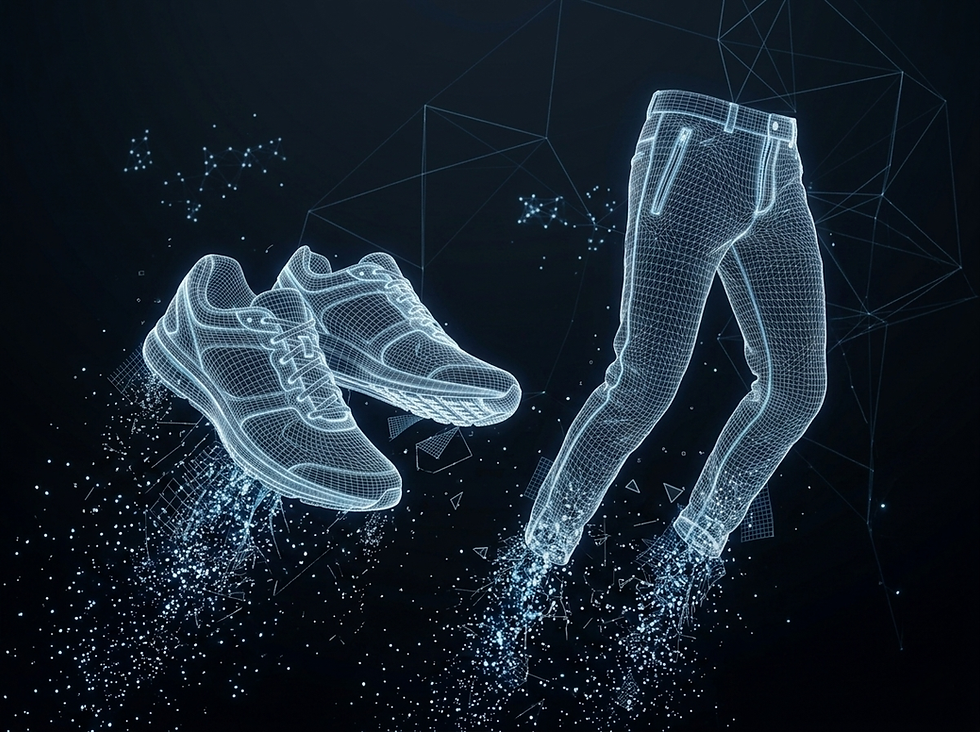
3D gives a garment a digital twin before it physically exists, a single accurate file that design, fit, visualization, and increasingly manufacturing can all read from. That is what turns Lageyre’s “seamless workflow” from an aspiration into an architecture. Generative AI adds speed and surface to that file: it can render a flat technical drawing as a photorealistic garment, populate a lookbook from a 3D simulation, or generate the visual a customer actually responds to, all from the same underlying asset.
Most of the industry currently frames generative AI as a creativity accelerator: faster mood boards, synthetic models, quicker campaign copy. That framing is not wrong, but it is small. It treats GenAI as a better front end bolted onto the same forecast-and-bulk machine behind it.
The part no one is saying out loud
Here is the idea we keep coming back to, and the one we think the industry has not fully registered yet.
The digital asset is not just a creative output. It is the production substrate.
The 3D file, the generated photorealistic image, the spec sheet, the fit profile, these are usually treated as things you make in order to sell or manufacture a garment. But when the same asset can simultaneously be the thing a customer browses, the thing they order, the fit data the factory needs, and the instruction set a 3D loom or automated line acts on, then demand and production stop being two separate phases stitched together by a forecast. They become one continuous object.
Think about what that actually removes. A photorealistic GenAI render that doubles as the order means there is no translation step between what the customer saw and what gets made, no sample round, no re-specification, no guessing at volume. The asset carries everything. We have seen early versions of this in practice already, using AI to turn technical drawings into photorealistic garments for vendor communication, and moving from a pattern to a 3D simulation to a finished lookbook image without a physical prototype in between. Each of those is a small collapse of the intent-to-garment gap. Stacked together, they describe a production model where the digital asset is the product until the last possible moment, and the physical garment is just its final render.
That is the version of on-demand that becomes genuinely scalable. Not because brands decided to be more responsible, though they should, but because the tooling finally makes the responsible thing the efficient thing.
What this unlocks
None of this arrives overnight, and it will not replace mass production wholesale. The brands we spoke with were realistic: most expect hybrid models, on-demand for some lines and traditional production for others, for a long while yet. Cost, manufacturer readiness, and consumer patience are all genuine constraints.
But the direction is hard to miss. Every advance in DPC, every improvement in 3D fidelity and generative capability, shortens the distance between a customer’s intent and a finished garment. And as that distance approaches zero, the original logic of making clothes, produce what is wanted, when it is wanted, stops being the expensive option.
We did not lose on-demand fashion because it was a bad idea. We lost it because we lacked the tools to do it at scale. Those tools are now arriving, and they are digital first. The interesting question is no longer whether on-demand can work. It is what fashion looks like when the garment is digital before it is ever physical, and how much of the waste, the guesswork, and the overproduction simply has nowhere left to hide.
This post draws on our Fashion Reset 2.0: Demand Chain research, based on in-depth interviews with on-demand fashion brands and the technology providers enabling them. A fuller version of that research was originally published by Seamless by PI on Jan 2, 2025. Co-authored with Julia Chinakaeva.



Comments